


Help Your Child Overcome Balance and Gait Difficulties
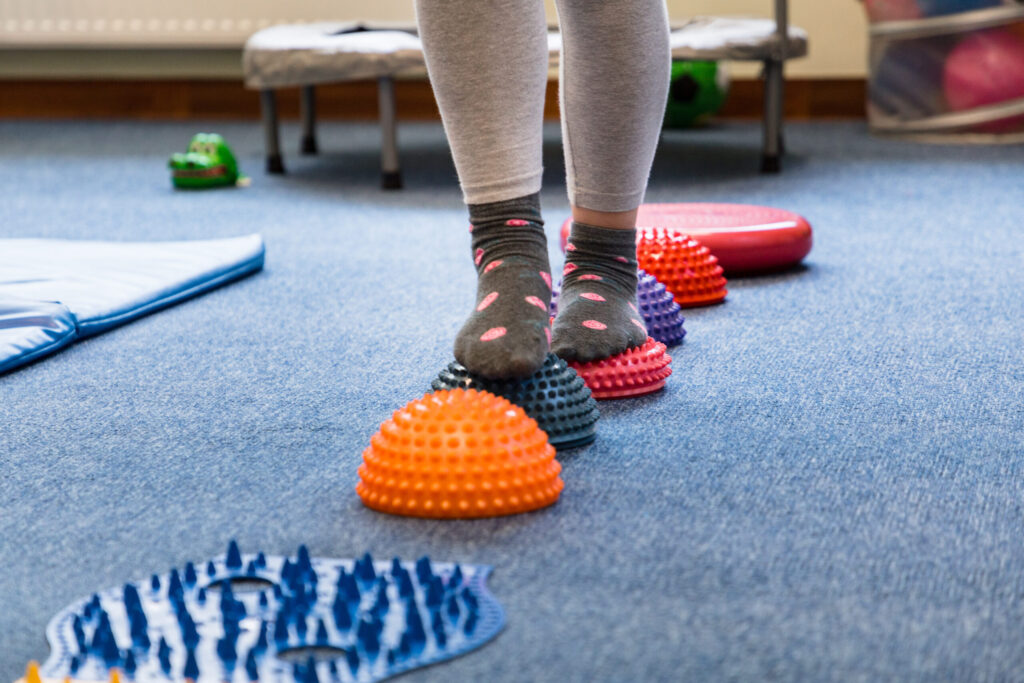
Diana first noticed that her son had difficulty walking when he was about two years old. He had taken a little longer than most kids to start walking on his own, and she saw that when he did start walking, he did so with his feet turned inward. Immediately, she brought him into Skills on the Hill to have his balance and gait evaluated.
As it turned out, Diana’s son had tibial torsion, in which his shin bone turned inward. The good news is that tibial torsion typically isn’t a permanent condition, and that proved true for Diana’s son. He worked with our pediatric therapists to strengthen his leg muscles and performed targeted training to address his balance and gait difficulties.
Within a year, Diana’s son no longer walked with that inwardly turned gait. More importantly, he thrived on the playground, running and playing with his friends.
Several conditions can cause balance and gait difficulties in children. Our pediatric therapists can help you understand which one is affecting your child and provide personalized treatment based on your child’s unique needs. Schedule an appointment at our Washington, DC or Arlington, VA clinic today to get started!
Identifying Balance and Gait Difficulties in Children
We typically associate balance and gait issues with adults, particularly older adults, and for good reason: they simply aren’t that common in children. When they do occur, they typically stem from either development issues (such as tibial torsion) or an underlying disorder (such as Down’s syndrome).
The best thing for you to do is keep track of your child’s developmental milestones, particularly those related to moving and walking:
- Most babies start crawling at 6-9 months
- Most start pulling themselves up to stand at 9 months
- Most start cruising at 9-12 months
- Most start walking on their own at 11-13 months
These milestones are guidelines, not firm dates, but if your child misses one by a significant margin, it’s vital that you bring them in for an assessment. It will help you understand what’s going on with your child so you can seek appropriate treatment.
How We Treat Pediatric Balance and Gait Disorders
When it comes to balance and gait difficulties, there’s no one-size-fits-all approach! Treatment will depend on their exact symptoms and the underlying cause of their difficulties. Here are a few examples:
Meredith
When Meredith first began walking, she tended to do so on her tip-toes. Her doctor reassured her parents this was typical in young children and should go away on its own. When it didn’t, Meredith’s parents brought her to us for an evaluation.
After a thorough evaluation, the pediatric therapist confirmed that Meredith’s Achilles tendon was too tight, which led to her unusual gait. We then developed a fun, playful treatment program to stretch out Meredith’s calf and ankle tissue. We also worked with her to improve her overall walking pattern.
Oliver
When Oliver was just a baby, his parents noticed that he often felt “floppy” when they picked him up. When he missed a few key developmental milestones related to movement, including walking independently, they had him assessed.
They discovered that Oliver had cerebral palsy, a neurological condition that affects movement and posture. We immediately began working with Oliver to help him improve his gross motor skills. Our pediatric therapists guided Oliver through playful exercises to help him get strong and flexible and improve his balance.
While cerebral palsy doesn’t have a cure, regular pediatric therapy helped Oliver manage his condition, including the balance and gait difficulties that come along with it.
Help Your Child Thrive with Pediatric Therapy
Leaving your child’s balance and unaddressed gait difficulties can significantly impact their overall quality of life. Fortunately, Skills on the Hill offers a fun, welcoming environment where your child can work to improve their specific balance and gait issues–regardless of what they are or what caused them.
We understand that no kid wants to go to the doctor multiple times a week, so we strive to make our treatments feel as little like a doctor’s visit as possible! We tailor all exercises to each child’s age and abilities and work to make them feel like play, not work. When your child looks forward to their sessions, we know we’ve done our jobs!
If you have any concerns about your child’s balance or walking patterns, request an appointment with us today.
Sources:
https://cparf.org/what-is-cerebral-palsy/signs-and-symptoms-of-cerebral-palsy