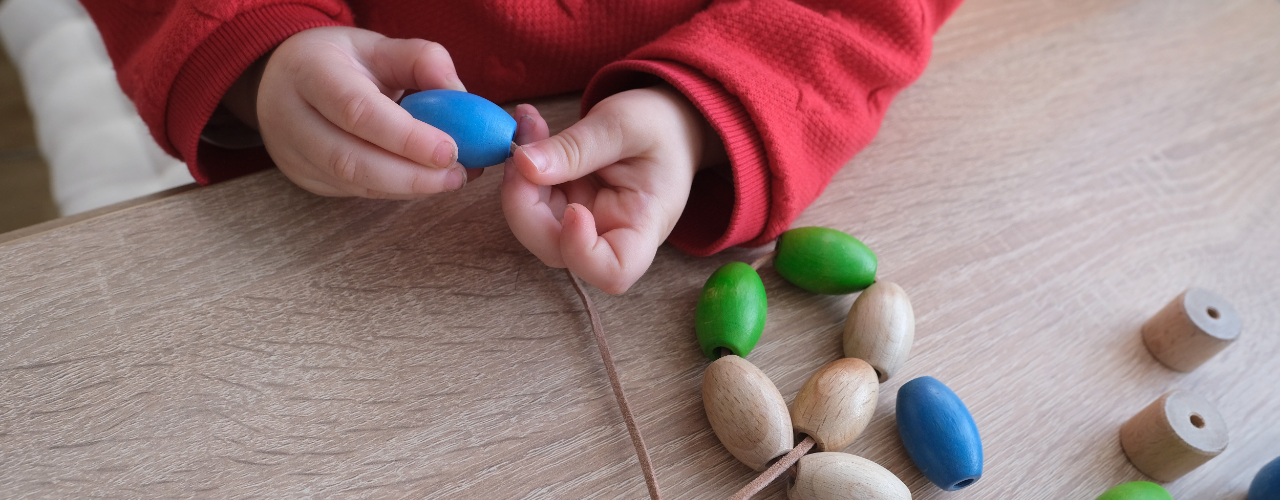


When we are very young, we gain the use and coordination of the muscles in our trunk, arms, legs, and hands. Sensory information coming in through our bodies and from the environment also influences how we move. Challenges in this area can sometimes lead to a sensory-motor disorder.
What is a sensory-motor disorder?
Sensory motor skills involve the process of receiving sensory messages (sensory input) and producing a response (motor output.) Our bodies receive information from our environment through our vision, hearing, smell, taste, touch, vestibular, and proprioceptive systems.
Sensory-motor issues may include but are not limited to trouble sitting, crawling, and walkin, catching a ball or using toys, dancing or doing gymnastics, dressing independently, or writing, coloring, or drawing.

How can pediatric therapy at Skills on the Hill help?
At Skills on the Hill in Washington, DC, and Arlington, VA, our pediatric therapists understand and know how to treat a variety of issues.
Your child’s occupational therapist will first perform an evaluation, including taking a complete medical history. A sensory questionnaire will also be provided to the parent so the therapist can obtain information about how your child responds to individual types of sensory input.
During the evaluation, the occupational therapist may assess several motor skill areas, coordination, balance and postural control, attention, toleration of different types of movement, responses to touch, activity and arousal level, and sequencing and following instructions.
Following the evaluation, you will be provided with a comprehensive report that summarizes impressions and includes recommendations for next steps. In addition, a meeting will occur so the therapist can explain details from the evaluation, answer questions you might have, and offer a description of what therapy will look like if recommended.
Our therapists will put together a treatment plan to ensure your child’s success. Therapy for children who have sensory-motor disorders often involves playtime to teach them the correct way to hold toys and explore, as well as exercises and training to improve how they walk or run.
At Skills on the Hill, you can trust that your child’s sensory issues will be addressed and managed so that life is easier and more successful for your child, and for you!
What is sensory integration therapy?
Sensory integration therapy is a specialty area of practice within the field of occupational therapy. It involves the use of specialized equipment and sensory-rich activities to help a child improve his/her ability to take in, make sense of, and respond appropriately to input. At therapy clinics that use the sensory integrative treatment approach, you will see equipment that provides vestibular, proprioceptive, and tactile stimulation. What does that mean? See the below descriptions!
Vestibular System
This is the system that helps us understand how we are moving in space. Receptors in the inner ear tell us if we are moving up and down, in a linear direction, or spinning.
Proprioceptive System
This system allows us to sense where our body parts are when we are moving. Receptors in the muscles, tendons, and joints sense changes in movement and position of our joints.
Tactile System
This system allows us to perceive touch including pain and temperature as well as vibration and textures of objects. The receptors are located in our skin.
What does sensory integration therapy look like?
To the untrained eye, sensory integration therapy tends to look like play. But don’t be fooled! There is an important reason behind the selection of equipment made by the therapist or the child, the sequence in which tasks are set up and performed, and the level of challenge required.
Sensory Integration therapy is meant to be “child-directed” or “child-centered”. Whenever possible, the therapist includes activities that are motivating and interesting to the child so that he/she will want to engage. Also, the challenge of a therapy task is gradually decreased or increased depending on the child’s response, ability level, or rate of success. This way, the child thinks it is all play!
Call our clinic today for an appointment
If you’ve noticed your child having difficulty with any of the above-mentioned signs or symptoms that accompany a sensory-motor disorder, don’t waste any more time. Contact Skills on the Hill in Washington, DC, or Arlington, VA today for more information regarding the treatment of sensory-motor disorders in children. Our therapists are ready and waiting for your call!
Ready to get started?
Skills on the Hill in Washington, DC, or Arlington, VA pediatric therapists can help children with their sensory skills. If you believe your child is not meeting the proper milestones in regards to their sensory processing, contact us today.
Choose The Next Step For Your Child’s Path Forward
In-Person Screening And Consults
Not Sure If Pediatric Therapy Is Right For You?
Experience How We Can Help with In-person Screenings and Consultations.
Schedule Your Screening!Online Developmental Checklist
Concerned About Your Child’s Development?
Complete our online Developmental Milestone Checklist to learn whether your child is on track or may need extra support.
Get Answers Now!